
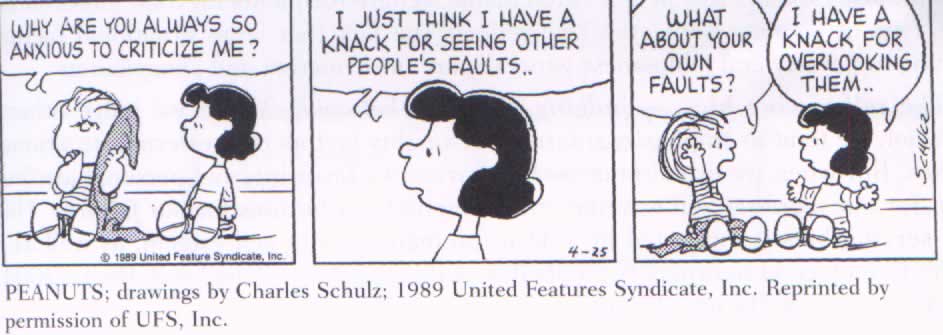
Kind of says it all, doesn’t it? He behaves badly because he’s a jerk. I may have behaved badly, and that’s not certain, but if I did, it’s because he provoked me. Ah, fundamental attribution error. Such a useful tool. So ready to hand, so over-used. Coined by Lee D. Ross, Stanford Federal Credit Union Professor of Humanities and Sciences at Stanford University. the term refers to our persistence in explaining other people’s behaviour in terms of their dispositions and our own in term of circumstances. We all do it.
Besides helping to uphold our glowing views of ourselves, why do we engage in this practice? There are three main explanations.
First up is the concept of a Just World, in which people get what they deserve and deserve what they get. This allows us to believe that the world is fair and we have control over our lives, all evidence to the contrary notwithstanding. It helps us find meaning in difficult situations, gives us a sense of security and decreases our perception of threats, all psychologically very useful. The downside is we tend to blame victims of tragedy or accident, like rape victims and people involved in domestic abuse. It allows us to hold ourselves apart, feeling we’re less likely to fall prey to these events. After all, the victims had it coming to them.
Next is called Salience of the Actor, or what grabs our attention. Seemingly more prominent in Western culture, we see people as the primary reference point, and the situation as noise, or background. When trying to figure out why someone acts a certain way, we’re more likely to focus on the individual and more inclined to overlook extenuating circumstances. We fail to observe ourselves, however, because we’re looking outward, and what captures our attention are the forces acting upon us.
Last is Lack of Effortful Adjustment. There’s a mouthful. It means that even though we may be dimly aware that someone might be responding to situational factors, we persist in attributing their behaviour to character. “Yes I know he just lost his wife after a prolonged and painful illness, but really, that’s no reason to be so grumpy. The guy is just a grouch.” We give lip service to the situation, but continue to believe the person’s disposition is the key factor, so that even if the situation was different, they would continue to behave poorly. I suspect this last one accounts for most of our denial that we, personally, commit fundamental attribution error, although others might, of course.
What to do?
Look for a trend or commonality in behaviour. If most people behave the same way when put in the same situation, then it’s likely the situation, rather than people’s traits. When faced with an abundance of late expense reports, despite repeated exhortations to get them in on time, could it be that the process is unnecessarily complicated, and your staff aren’t just stubborn and uncooperative?
Ask how we might behave in the same situation. Let’s be honest now, much as it might make us squirm.
Look for unseen causes, particularly those that are less obvious. I hadn’t heard from Lauren, my youngest daughter, for a few days, in spite of sending several text messages and e-mails. I was getting vaguely annoyed. Was she avoiding me? No, it turns out. Her boyfriend Jesse had inadvertently dropped her cell phone into a vat of oil at the restaurant where they both work as chefs. Not the first explanation that came to mind, I must say.
Ok, I’ll give that a shot. I’ll try to remember that circumstances may be contributing to how people behave. Too bad some people are just jerks, though.